
Explicit Graph Map Entry
Example 1
Consider the example on a genus 2 surface given in section 6.1 of Bestvina and Handel's paper (page 129). The edges there labelled a, b, c, and d will here be labelled 1, 2, 3, and 4 respectively.
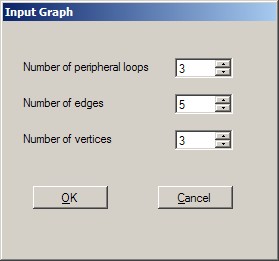
On pressing the Input button, you are prompted for the number of peripheral loops, edges, and vertices in the graph:
Next, enter the edges around the (unique) vertex in anticlockwise cyclic order (this has been read off from Figure 14 on page 130).

Click the Edges button to move on to giving information about the edges of the graph. You are prompted to enter the image edge path of each edge: press the >> and << buttons to move between edges.


Finally, hit the Submit button and the graph map input is complete.
Example 2
Consider the example on the 4-times punctured sphere given in section 6.2 of Bestvina and Handel's paper (page 136). The edges there labelled α, β, γ, a, and c will here be labelled 1, 2, 3, 4, and 5 respectively.
The only substantial difference from example 1 is that there are now peripheral loops in the graph:
Thus, when entering each edge, the program needs to know whether or not it is a peripheral edge. If it is, you are also prompted to enter the number of the puncture with which it is associated.


Copyright © 2007, Toby Hall, University of Liverpool
This help file has been generated by the freeware version of HelpNDoc